

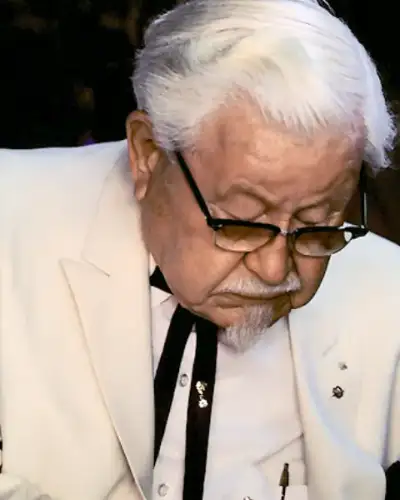
Before you read about launch funnels, email sequences and the Product Launch Formula, read about a man who did everything wrong for forty years — and then, at an age when most people are handed a retirement cake, did one thing right.
His name was Harland Sanders. You know his face. It is printed on buckets of chicken in more than a hundred countries. What most people don’t know is that the white suit, the goatee and the famous smile belong to a man who was fired from job after job, who watched his business burn, who saw a new highway drain the life out of his restaurant, and who started the work that made him famous while living on a government check.
This is his story, told from documented sources. No invented quotes, no “1,009 rejections” myth. Just what happened.
Chapter 1Colonel Sanders’ childhood: a stove, two siblings and no father
Harland David Sanders was born on September 9, 1890, near Henryville, Indiana. In 1895, when he was five years old, his father died. His mother went to work in a tomato cannery, and the oldest child — Harland — was left at home to look after his younger brother and sister.
So he cooked. Not because it was a passion project. Because someone had to. Long before he was a teenager, the boy who would become the most famous cook in the world was already feeding a family.
School didn’t last. In 1903, at the age of 12, he dropped out of the seventh grade. A year later he was painting horse carriages in Indianapolis. He was thirteen.
Most success stories start with a dream. This one starts with a hungry family and a boy who had to grow up fast.Chapter 2
Colonel Sanders’ forty years of false starts
If you have ever felt that you “should be further along by now,” the next part is for you.
Here is a partial list of the jobs Harland Sanders held, as recorded by his biographers:
- Farmhand.
- Streetcar conductor in New Albany, Indiana.
- U.S. Army wagoner in Cuba, 1906–1907.
- Railroad blacksmith’s helper, ash-pan cleaner and steam-engine stoker.
- Laborer on several railroads.
- Lawyer in Little Rock, Arkansas — a career of about three years that ended after a brawl in the courtroom with his own client.
- Life insurance salesman (Prudential, from 1916).
- Operator of a ferry company (1920).
- Secretary of a Chamber of Commerce (around 1922).
- Manufacturer of acetylene lamps — a business that failed.
- Michelin tire salesman — a job he lost in 1924.
- Operator of a Standard Oil service station in Nicholasville, Kentucky — closed in 1930, when the Great Depression arrived.
Read that list again. Thirteen different starts. Firings, a failed product, a business wiped out by an economic crisis. If you measured Harland Sanders at age 40, you would have called him a man who couldn’t hold a job.
You would have been wrong. But you would have had evidence.
Chapter 3Colonel Sanders in Corbin, Kentucky: the gas station that served dinner
In 1930 — in the middle of the Depression — the Shell Oil Company offered Sanders a service station in North Corbin, Kentucky, rent-free, in exchange for a percentage of sales. He took it. And because travelers who stopped for gas were also hungry, he started cooking for them: country ham, steaks, and fried chicken.
The food was good enough that people talked. In 1939, the food critic Duncan Hines listed Sanders’ place in his guide Adventures in Good Eating. For a roadside café in rural Kentucky, that was a national stamp of approval.
Then, in November 1939, a fire destroyed the restaurant and motel.
He rebuilt it — bigger, with 140 seats. And in July 1940, at age 50, he finalized the recipe he would guard for the rest of his life: chicken seasoned with a blend of herbs and spices and cooked in a pressure fryer, which made it faster than pan-frying and juicier than deep-frying.
Notice what happened here. The fire didn’t end the story. It reset the stage. And the breakthrough recipe arrived after the disaster, not before it.
Chapter 4KFC’s first franchise: a handshake in Utah
In 1952, a restaurant owner named Pete Harman, from South Salt Lake, Utah, began selling Sanders’ chicken. Harman became the first franchisee of what would be called Kentucky Fried Chicken. The deal was simple: four cents for every chicken sold.
It was a small idea with a giant consequence. Sanders didn’t need to own every restaurant. He needed his recipe, his process and his name in other people’s restaurants — and a share of each sale.
But at the time, his main business was still the restaurant in Corbin. It was doing well. And that is exactly when the world changed under his feet.
Chapter 5The highway that bypassed Colonel Sanders
In the 1950s the United States built its Interstate highway system. When Interstate 75 was planned, it did not pass by Sanders’ restaurant. The cars — the customers — went somewhere else.
There was nothing he could do about it. No amount of good chicken could change where the government put a highway.
At 65, Harland Sanders sold the Corbin restaurant. What he had left was his savings and a Social Security check of $105 a month.
Stop and picture it. A man in his mid-sixties, a business that took twenty-five years to build gone because of a road, a monthly check that would barely cover the basics. Most people in that position would have called it a life and gone quiet.
At 65 he had a recipe, a pressure cooker, a white suit and $105 a month. He decided that was enough to begin.Chapter 6
Colonel Sanders goes all-in on the road
He took the one thing the highway couldn’t take from him — the recipe and the method — and went looking for restaurants that would cook it. He threw himself into franchising full time. In 1959 he set up a restaurant and headquarters in Shelbyville, Kentucky.
The Colonel’s title, by the way, was an honorary one, granted by the state of Kentucky. But he wore it like a brand. The white suit and black string tie became his uniform. He understood something many entrepreneurs learn late: people don’t just buy a product, they buy the person and the story behind it.
By 1964 Kentucky Fried Chicken had more than 600 locations. That year, at age 73, he sold the company for $2 million to a partnership led by John Y. Brown Jr. and Jack C. Massey, and stayed on as its face and goodwill ambassador. He died on December 16, 1980, at the age of 90.
From a $105 check to a brand that outlived him. And the most productive chapter of his life began after 65.
What Colonel Sanders’ story teaches about launching a product
You don’t need to sell chicken to take something from this story. If you are thinking about launching a course, a coaching program, a membership or a book, here is what Harland Sanders’ life says to you.
Colonel Sanders lesson 1: it is not too late — and it is not too early
Sanders was 50 when he finalized his recipe, about 61 when Pete Harman became his first franchisee, 65 when he went all-in, 73 when he sold. If you are 45, 55 or 65 and wondering whether it is “too late” to start an online business, his life is an answer.
The reverse is also true. If you’re 25 and think you need more credentials first, remember the boy who was cooking for his family before he was a teenager. Skill grows by doing.
Colonel Sanders lesson 2: the highway always moves — own your audience
For twenty-five years Sanders depended on traffic he did not control. When the road moved, his customers vanished.
Today the “highway” is an algorithm. A social network changes its rules, a platform bans a type of ad, search traffic drops overnight — and a business built on borrowed attention empties out like Corbin after I-75.
This is one reason Jeff Walker’s Product Launch Formula puts so much weight on building an email list: an audience you can reach directly, whatever the algorithms do. Our guide to the Launch Conga Line explains how each launch grows that list for the next one.
Colonel Sanders lesson 3: your recipe is not your business — your system is
The chicken was great in 1940. It didn’t make Sanders famous until it was packaged into a repeatable system: a recipe, a cooking process, a brand, and a way to bring it to many restaurants at once.
Many experts sit on a “great recipe” — real knowledge, a real skill — and wait for people to discover them. A launch is the system that carries your knowledge to the people who need it. Jeff Walker’s method gives that system a shape: a pre-prelaunch to test interest, a short series of free prelaunch content, an open cart with a real deadline, and a close.
Colonel Sanders lesson 4: start small, with one partner
KFC didn’t start with 600 locations. It started with Pete Harman in Utah and four cents a chicken. One partner, one proof that the system worked outside Corbin.
In the language of Jeff Walker’s method, that’s a seed. A Seed Launch is a small launch to a small audience — sometimes a few dozen people — that proves your offer works before you build the big version. Most successful launchers started there.
Colonel Sanders lesson 5: be the face of what you sell
The white suit was not an accident. Sanders put himself — his story, his look, his personality — at the center of the brand. That is exactly what prelaunch content does in a launch: it lets people meet you, hear your story and trust you before you ever ask for a sale.
The day Colonel Sanders could have quit
Every story like this has a moment where quitting would have been completely reasonable. For Sanders there were several: the courtroom brawl, the failed lamp business, the Depression, the fire. But the one that matters most is the highway.
At 65, with a reasonable excuse and a monthly check, he could have stopped. Nobody would have blamed him. Instead, he took the one asset he still had and found a new way to bring it to people.
Maybe you have your own highway right now — a job that ended, a business that slowed, an age you think is “too late,” a first launch that sold three copies. The road moved. Your recipe didn’t.
When you’re ready to see how Jeff Walker teaches people to carry their “recipe” to a market — live, with a deadline and a real offer — he presents it on the third video of his weekly class.
A note on Colonel Sanders myths
You may have read that Colonel Sanders was rejected 1,009 times before anyone accepted his recipe, or that he started at exactly 62. We couldn’t confirm those claims in reliable sources, so we don’t repeat them as fact. The documented story — told above, with references below — doesn’t need embellishment.
And to be clear: Harland Sanders has no connection to Jeff Walker, Product Launch Formula or PLF Reviews. We tell his story because the lesson is universal. If it moved you, the best next step is a small one: register for this week’s free Launch Masterclass and watch how a launch is built, one video at a time.
References: where this story is documented
Every fact in this story was checked against the sources below. Quotes are short and attributed; dates and figures follow these references.

Marciano reviews Jeff Walker's public training, the book Launch and the official program pages, and keeps these guides updated. PLF Reviews is an independent affiliate site — not Jeff Walker or Internet Alchemy, Inc. How we review · Affiliate disclosure
Last updated October 11, 2026