

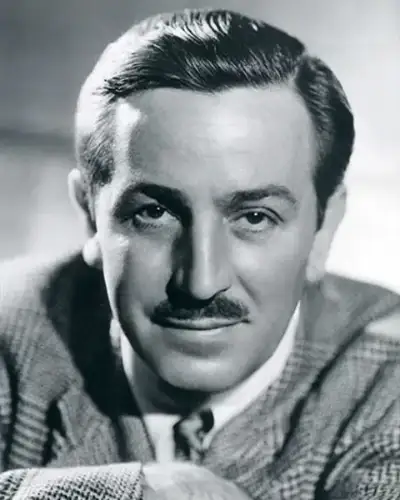
If you think you need a perfect track record before you launch anything — a course, a coaching program, a membership built on the Product Launch Formula — meet a young man who went bankrupt at 21, left town with a cardboard suitcase, and five years later lost almost everything a second time.
His name was Walt Disney. Today the name means castles, fireworks and a company worth more than many countries. In 1923 it meant unpaid bills.
This is the documented story — the bankrupt studio, the stolen rabbit, the mouse, and the film everyone called a folly. Sources are listed at the end.
Chapter 1Walt Disney’s early jobs: newspapers, ink and a layoff
Walter Elias Disney was born in Chicago in 1901 and grew up mostly in Missouri. As a boy in Kansas City he and his brother Roy delivered newspapers — The Kansas City Star and the Kansas City Times — for more than six years. Early mornings, heavy bags, every day.
He loved to draw. In October 1919 he got a job as an apprentice artist at the Pesmen-Rubin Commercial Art Studio in Kansas City, where he met another young artist named Ub Iwerks. In January 1920, both of them were laid off.
So far, a familiar story: talented kid, entry-level job, let go.
Chapter 2Laugh-O-gram: Walt Disney’s first company goes bankrupt
In May 1921 Disney founded his own animation company, Laugh-O-gram Films, in Kansas City. He hired artists, produced short cartoons based on fairy tales, and believed this was the start of something.
It wasn’t — not yet. The money didn’t come in fast enough. In 1923 Laugh-O-gram went bankrupt.
The Walt Disney Family Museum describes what that summer looked like: Walt was struggling to pay for regular meals, let alone a train ticket. To raise money he went door to door offering to film families for a small fee. In the end, he sold his movie camera.
He was 21, his company had failed, and he sold the tool of his trade to pay for a ticket out of town.
In late July 1923 he boarded a train for Los Angeles. He packed a frayed cardboard suitcase with his personal things and carried one reel of film: an unfinished short called Alice’s Wonderland. That reel was his whole portfolio.
Chapter 3Walt Disney’s second chance in Hollywood
He arrived in early August 1923. In October he signed a contract with a distributor, Winkler Pictures, for a series of Alice Comedies — a live-action girl in a cartoon world. The series ran until July 1927. Roy joined him, and slowly a small studio took shape.
Then came a character who changed his fortunes: Oswald the Lucky Rabbit. Oswald was a hit. For the first time, the Disney studio had a star audiences recognized.
And for the first time, Walt had something to lose.
Chapter 4February 1928: the day Walt Disney lost Oswald
In February 1928, Walt went to New York to negotiate a better deal with Charles Mintz, who distributed the Oswald cartoons. He asked for a larger budget.
Mintz refused. Worse, Walt learned two things that would have broken many people:
- Universal, not Walt Disney, owned the rights to Oswald. The character he and his team had created and made famous was legally someone else’s.
- Mintz had quietly hired away most of Disney’s animators.
Walt said no to Mintz’s terms. He walked away from his own star. Of his animators, only Ub Iwerks — the friend from the 1920 layoff — stayed.
Picture the train ride home. A young man who had already been bankrupt once, now without his main character, without most of his team, with a contract that had just collapsed.
Chapter 5Mickey Mouse: born after the loss
It was in 1928, right after losing Oswald, that Walt Disney and Ub Iwerks created a new character: a mouse. The Walt Disney Family Museum’s story of “the birth of a mouse” places Mickey’s creation in that same year of crisis.
Mickey Mouse first appeared in May 1928 in a test screening of Plane Crazy. It didn’t find a distributor. A second short followed. Then Walt made a bet: the third Mickey film, Steamboat Willie, would have synchronized sound — the first post-produced sound cartoon. It became the breakthrough.
The character Walt created after losing everything became one of the most recognized characters in history. And this time, the rights stayed with Disney.
Oswald was the character he lost. Mickey was the character he owned.Chapter 6
Breakdown, “Disney’s Folly” and Snow White
Success didn’t make life easy. In October 1931, Walt suffered a nervous breakdown, which he blamed on overwork and on the business tactics of a former partner. He took time off, then came back.
In 1934 he started his most dangerous project: a full-length animated feature, Snow White and the Seven Dwarfs. People in the industry called it “Disney’s Folly.” Who would sit through more than 80 minutes of a cartoon?
Production took four years. The film cost $1.5 million — three times its budget. It premiered in December 1937 and became a historic success. Later came Disneyland, which opened in Anaheim, California, in July 1955.
From a cardboard suitcase to a theme park in 32 years.
What Walt Disney’s story teaches about launching a product
Walt Disney lesson 1: own your audience, not just your idea
The most painful part of Walt’s story isn’t the bankruptcy. It’s discovering that the character he built belonged to someone else. He did the work; another company owned the asset.
Online entrepreneurs face a version of this every day. Your followers on a platform are, in a real sense, the platform’s. Your ads account can be closed. Your reach can be cut overnight. Jeff Walker’s Product Launch Formula teaches launches built around an email list — an audience you can reach directly. It’s the Mickey lesson: build the asset that stays yours. The Launch Conga Line guide shows how each launch grows that asset.
Walt Disney lesson 2: your first company is not your last
Laugh-O-gram failed. That failure gave Walt experience, a portfolio reel and a reason to move to the city where animation was about to explode. Many successful launchers will tell you their first product didn’t sell much. The point of a first launch is not to be perfect; it’s to learn, to get a few customers and to build the base for the next one.
Walt Disney lesson 3: add the thing nobody else has
Steamboat Willie didn’t win because it was another cartoon. It won because it had synchronized sound when others didn’t. In a launch, your “sound” might be your story, your specific method or the result your customers get. Jeff Walker’s method calls these mental triggers — proof, story, uniqueness — and builds them into the free prelaunch content. Our guide to mental triggers explains them one by one.
Walt Disney lesson 4: big launches need a long runway
Snow White took four years. The PLF approach to big launches is similar in spirit: you don’t announce a product on Monday and expect a crowd on Tuesday. You build anticipation step by step — the pre-prelaunch, the prelaunch videos, the open cart.
Walt Disney lesson 5: keep the people who stay
When almost everyone left, Ub Iwerks stayed. Every business has its Ub — the first customer, the first partner, the friend who believes before the results arrive. Treat them like gold.
The moment Walt Disney could have quit
He could have quit in 1923, in Kansas City, with a bankrupt company and a camera to sell. He could have quit in 1928, on the train back from New York. He could have quit in 1931, exhausted. He didn’t — and each time, the next chapter was bigger than the one that ended.
When you’re ready to see a complete launch system taught from start to finish, Jeff Walker presents it live in his weekly class.
A note on Walt Disney myths
You may have read that Walt Disney was fired from a newspaper “for lacking imagination.” We didn’t find that claim in the biographical sources we checked, so we leave it out. The documented losses — a bankrupt company at 21, a stolen character at 26, a breakdown at 29 — tell the story well enough.
Walt Disney has no connection to Jeff Walker, Product Launch Formula or PLF Reviews. If his story reminded you that a setback can be the beginning of the next chapter, take one small step today: register for Jeff Walker’s free Launch Masterclass.
References: where this story is documented
Every fact in this story was checked against the sources below. Quotes are short and attributed; dates and figures follow these references.

Marciano reviews Jeff Walker's public training, the book Launch and the official program pages, and keeps these guides updated. PLF Reviews is an independent affiliate site — not Jeff Walker or Internet Alchemy, Inc. How we review · Affiliate disclosure
Last updated October 11, 2026